
Honda Accord
Front Brake Pads Replacement Guide
How to guide for replacing the front
brake pads on a 2008 to 2011 Honda Accord with pictures & step by step
instructions.

| Please note, I am not a professional mechanic. This guide is for illustrative purposes only. If you have any doubts, do not proceed and consult with your dealership. I assume no responsibility for damage to your vehicle, persons, property or pets. | ||
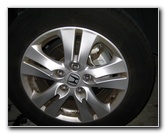 Accord Front Wheel |
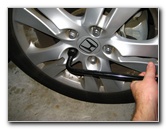 Loosening Lug Nuts |
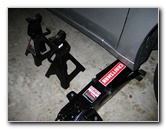 Jack & Jack Stands |
| This
automotive "how-to" guide was specifically written to assist owners
of the eighth generation (2008, 2009, 2010, 2011 & 2012) Honda Accord in changing the
front brake pads. Owners of other Honda vehicles such as the Civic, CR-V, CR-Z, Element, Fit, Insight, Odyssey, Pilot and Ridgeline may also find this guide to be useful. The tools and other items needed for this procedure include a lug nut wrench, a floor jack, two jack stands, a 12mm socket, a 3/8" drive ratchet, a "C" or "F" clamp and a tube of brake caliper grease. A few compatible replacement brake pads with their part numbers are as follows: Wagner QC914, Akebono ACT914, Bosch BC943, Bendix D914CT CT-3, TRW TPC0914, Raybestos ATD914C and Centric Parts 106.09140. |
||
|
|
||
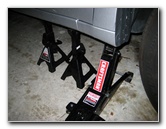 Car Jacked Up |
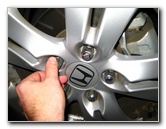 Remove 5 Lug Nuts |
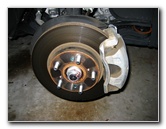 Wheel Removed |
| The first step is
to slightly loosen the five lug nuts on each front wheel with the lug nut
wrench located on top of the spare tire in the car's trunk.
Then jack up the side of the car and secure it with two jack stands. I prefer to work on one wheel at a time and secure that corner of the car with both of my jack stands for extra safety. Next remove the lug nuts and pull off the front wheel to reveal the brake caliper and rotor. |
||
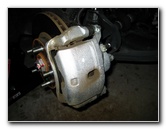 Rotor & Caliper |
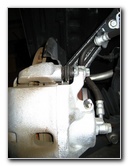 Top of Caliper |
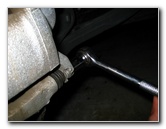 12mm Lower Caliper Bolt |
| To access the brake
pads in the front caliper, you'll need to remove the lower caliper bolt with
a 12mm socket or wrench.
The bolt head faces inwards to the wheel well of the car on the back side of the caliper. After removing the lower caliper bolt, rotate the caliper upwards off the pads and rotor. If the caliper doesn't remain in the up position by itself, secure it with some twine to the suspension to prevent it from crashing down on your fingers. Pull the old inner and outer brake pads out of the bracket. I recommend buying the Wagner ThermoQuiet QC914 brake pads since they have great reviews on Amazon. I also like how they don't require any backing plates, shims or disc brake quiet due to the built in insulators. |
||
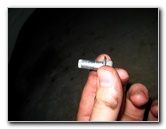 12mm Bolt Removed |
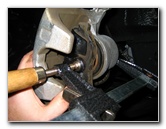 Raise Caliper Up |
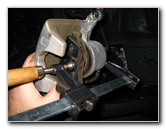 Attach C Clamp |
| In order for the
new and thicker brake pads to fit into the caliper, you'll need to place one
of the old pads and a "C" or
"F" clamp on the brake caliper piston and very slowly
push it back.
Be sure to remove the cap on the brake fluid reservoir in the engine bay to prevent pressure from building up in the brake fluid lines while you compress the caliper piston back. |
||
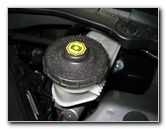 Brake Fluid Reservoir |
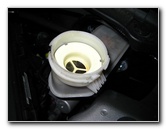 Remove Reservoir Cap |
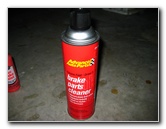 Brake Parts Cleaner Spray |
| Once the brake
caliper piston is pushed in just far enough for the caliper to fit over the
new brake pads, check that the brake fluid in the reservoir is at the "Max"
level.
If it is above it, remove a bit with a spray bottle head, a turkey baster, or soak some up with a paper towel. If the level is too low, add a bit of fresh DOT 3 brake fluid until it reaches the cold "Max" line. |
||
|
|
||
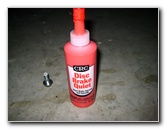 CRC Disc Brake Quiet |
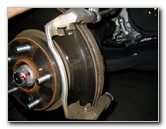 Brake Pads Removed |
 |
| Before installing
the new brake pads, clean the caliper and rotor with some brake parts
cleaner spray.
If your car is prone to brake squealing, apply a product such as the CRC Disc Brake Quiet gel to the back of the new pads where they come in contact with the caliper. |
||
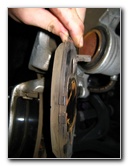 Wear Indicator Bar |
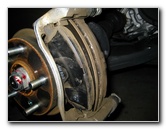 Insert New Brake Pads |
 Lower Brake Caliper |
| Attach the wear
indicator bar from the old brake pad to the top of the new interior brake
pad.
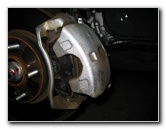
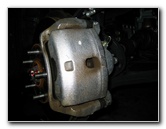
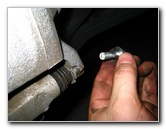
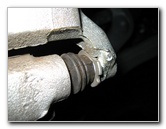
Then slide the new brake pads into place against the rotor. They only go in one way, so don't force the pads in which may damage the anti-rattle clips. With the pads securely in place, lower the caliper down over the new pads and onto the rotor. Make sure that the lower caliper pin's dust boot lines up with the notch on the caliper body. Then tighten the 12mm caliper bolt to just past hand tight. It's best to tighten the brake caliper bolt with a torque wrench to about 26 ft-lbs of torque. |
||
 Brake Caliper In Place |
 Line Up Caliper Pin Dust Boot |
 Tighten 12mm Bolt |
| If your brake pedal
felt soft or "mushy" or the brakes were prone to "fading" before you changed
the pads, this is a good time to bleed the brake lines to remove impurities
or moisture in the brake fluid. Check out my
Brake Line Bleeding Guide for more info on that subject. If your car shakes or vibrates while braking, you should either have the brake rotors "turned" at a repair shop or just replace them with new rotors depending on your vehicle's mileage. Replace the front wheel and spin on the five lug nuts in the clockwise direction. Slightly tighten the lug nuts in a criss cross or "star" pattern. Lower the car from the jack stands by using the floor jack. Tighten the lug nuts to about 1/4 turn past hand tight or about 80 ft-lbs of torque. It would be best to use a torque wrench. To break in the new brake pads, just drive normally for a few hundred miles to allow the brake pad material to evenly transfer onto the rotors. This is called "mating" and helps the brake pad and rotor to stop the car smoothly and quietly. Try to avoid hard braking or
"panic stops" during the break-in period to prevent "brake pad glazing"
which can result in noisy brakes that don't stop well. |
||
| For more of my
automotive how-to guides and product review, click on the following links:
Honda Accord Engine Oil Change Guide,
Honda
Accord Rear Brake Pads Replacement Guide,
Honda
Accord Headlight Bulbs Replacement Guide,
Honda
Accord PCV Valve Replacement Guide,
Honda Accord Tail Light Bulbs
Replacement Guide,
Honda Accord Cabin Air Filter Replacement Guide,
Honda Accord Overhead Map Light Bulbs Replacement Guide,
Honda Accord Key Fob Battery Replacement Guide,
2009 Honda Accord Review,
WeatherTech FloorLiner Car Mats Review,
Meguiar's Headlight Restoration Kit Review,
Zaino Bros Show Car Polish Review,
Corroded Car Battery Terminal Replacement Guide,
Falken Ziex ZE-512 Tire Review,
K&N Air Filter Cleaning Guide, and
Fuzion ZRi Tire Review. For more,
check out my other
2008-2012
Honda Accord Repair & Maintenance Guides. |
||
If you found this guide to be helpful,
please consider making a small donation by clicking on the PayPal.com
"Donate" button located to the right of this paragraph. Thank you!
 (Note: I am not a registered charity. Donations are not tax deductible.) |